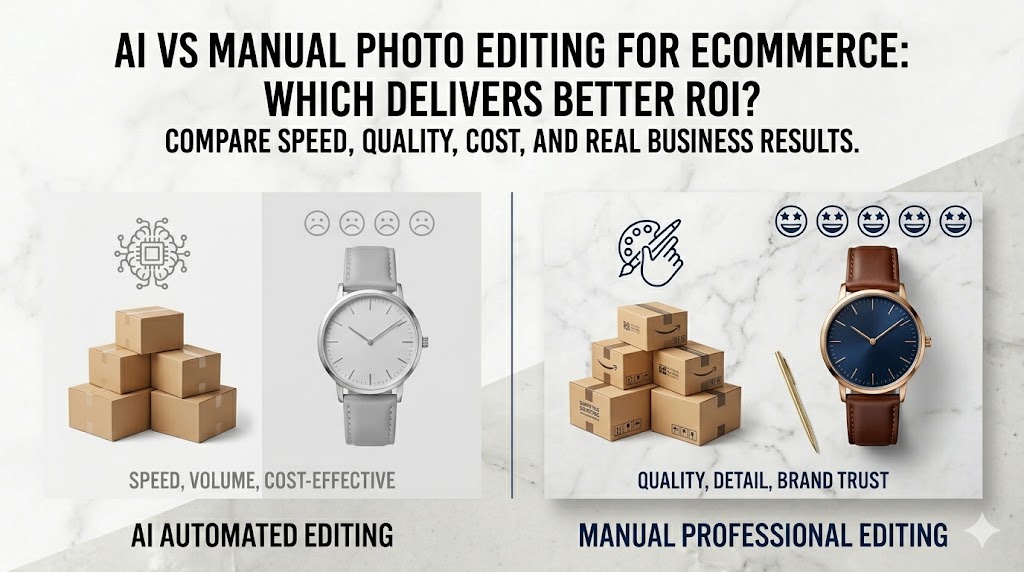
The AI vs manual photo editing debate is one every eCommerce seller faces: more product images, faster, and cheaper. AI editing promises all three, while manual editing promises quality you can trust.
So which wins the AI vs manual photo editing debate on ROI? The honest answer is that it depends on your catalog, your products, and what a single bad image costs you.
This guide breaks down the AI vs manual photo editing differences — the real numbers, the hidden trade-offs, and a clear framework to decide where your editing budget belongs.
The ROI Question, Reframed
The AI vs manual photo editing ROI calculation is not just about the cheapest price per image. It is about the total return after you account for conversions, returns, and your own time.
A $0.10 AI edit that causes a return is more expensive than a $5 manual edit that converts. The price tag is only one side of the equation.
To compare AI vs manual photo editing fairly, you have to weigh three things: cost per image, quality and conversion impact, and the hidden cost of bad images.
Cost: Where AI Wins on Paper
There is no contest on raw cost in the AI vs manual photo editing comparison. AI editing is dramatically cheaper per image than traditional manual workflows.
Industry data shows AI vs manual photo editing cost differences can be dramatic: AI tools cut editing and production costs by 80 to 95 percent compared to traditional photography and manual retouching workflows.
Here is how the costs typically compare:
- Traditional photography and editing: $20 to $150+ per image depending on complexity
- AI editing tools: roughly $0.03 to $2.99 per image
- A 500-SKU catalog: $10,000 to $75,000 traditionally, versus $500 to $2,000 with AI
These savings are real and they compound at scale. For a large catalog, the cost gap runs into tens of thousands of dollars.
One frequently cited case shows the scale of the savings. A Japanese reseller using an AI editing API processed 24,000 photos monthly, saving roughly 600 hours of manual work and about $80,000 a year. You can read more in Photoroom’s overview of AI product photography tools.
Quality: Where Manual Editing Earns Its Keep
Cost is only half the AI vs manual photo editing ROI story. The other half is whether the image actually sells the product, tells the truth about the product, and prevents returns.
AI has closed the quality gap fast. For the AI vs manual photo editing comparison on simple products with clean backgrounds, modern AI tools produce results that are hard to distinguish from human edits.
But the AI vs manual photo editing quality gap reappears with complex products. AI still struggles with the details that matter most in high-consideration purchases.
Where AI Quality Breaks Down
AI editing tends to falter in predictable places:
- Fine fabric detail — wrinkles, drape, and texture on apparel can look unnatural
- Reflective and transparent items — glass, jewelry, and glossy surfaces confuse algorithms
- True color accuracy — AI may shift a precise brand shade, creating return risk
- Intricate edges — hair, fur, lace, and fine straps often get cut imperfectly
- Brand-specific styling — automation cannot read your unique merchandising vision
For complex, high-consideration products, the AI vs manual photo editing choice is clear: a skilled human editor still delivers a level of precision and judgment that automation cannot match.
Where AI Quality Shines
AI is genuinely excellent at high-volume, repetitive tasks. It handles these reliably and instantly:
- Background removal on simple products
- Bulk resizing and cropping for different platforms
- Basic color and lighting correction
- Catalog-wide standardization across hundreds of SKUs
- Generating quick background variations for testing
This is the central pattern in the AI vs manual photo editing comparison. AI excels at scale and speed; humans excel at nuance and accuracy.
Speed and Volume: A Decisive Factor
Speed is where AI delivers ROI that manual editing simply cannot. What takes a human editor minutes per image, AI completes in seconds.
For a seller launching hundreds of SKUs a season, this speed translates directly into faster time to market. Products reach listings sooner, which means revenue arrives sooner.
Manual editing, by contrast, is bound by human hours. Quality is high, but throughput is limited and turnaround is slower.
If your competitive edge depends on launching fast and often, AI’s speed advantage is hard to ignore.
The Hidden Cost Most Sellers Ignore: Returns
The cheapest edit in the world loses money if it drives returns. This is the ROI factor sellers most often overlook.
An AI edit that subtly shifts a product’s color or misrepresents its texture sets a false expectation. When the product arrives looking different, the customer returns it.
Each return carries a real cost in shipping, labor, and restocking, plus the lasting damage of a negative review. For categories like apparel, where returns already run high, an inaccurate image is a direct hit to margin.
This is why quality is not a luxury. An accurate image is a return-prevention tool, and that prevention has measurable ROI.
The Verdict: It Is Not Either-Or
After weighing cost, quality, speed, and returns, the industry has landed on a clear consensus. The best ROI rarely comes from choosing one method exclusively.
The smartest approach is a hybrid workflow. You use AI for the repetitive, high-volume work and human editors for the images where quality drives the sale.
Industry analysis supports this directly. A hybrid model uses automation for repetitive production tasks and expert review where image quality, realism, or merchandising precision matter more, as detailed in this breakdown of AI versus manual editing.
A Simple Framework to Decide
Use this quick framework to route each image to the right method. It maximizes ROI without overthinking every photo.
Lean toward AI when:
- You have a large catalog of simple, similar products
- Speed and time to market are your priority
- You need bulk background removal or resizing
- Budget is tight and products are low-complexity
Lean toward manual editing when:
- You sell apparel, jewelry, glass, or reflective items
- Exact color accuracy is critical to the purchase
- The product is high-value or high-consideration
- Your brand depends on a distinctive, polished look
Use both when:
- You run AI for the first pass and human review for quality control
- Your catalog mixes simple and complex products
- You want speed without sacrificing your hero images
Most growing brands fall into that final AI vs manual photo editing hybrid category. The hybrid path captures AI’s savings while protecting the images that actually close sales.
Get a Free Test Image and Compare for Yourself
Talking about quality is one thing. Seeing it on your own product is another.
That is exactly what we offer at Photo Fix Team. We deliver the human precision that protects your conversions, with the consistency and turnaround that keep your catalog moving.
See the difference on your hardest image. Send us one product photo, especially a tricky apparel, jewelry, or reflective item, and we will edit it to professional standards, completely free. Claim your Free Test Image here and judge the quality against any AI tool.
Calculating Your Own ROI
To find your real answer, run a simple calculation for your business. Plug in your own numbers rather than relying on averages.
Start with these inputs:
- Your current cost per image across your catalog
- Your average product margin and order value
- Your return rate, and how much of it traces to image issues
- The hours you or your team spend editing each week
When you weigh editing cost against conversions and returns, the right mix becomes obvious. For high-margin or return-prone products, quality pays for itself. For simple, low-cost items, AI’s efficiency wins.
The Bottom Line on ROI
AI editing delivers unbeatable cost and speed for simple, high-volume work. Manual editing delivers the accuracy and trust that protect your margins on complex products.
The highest ROI comes from matching the method to the image, not from picking a side. Use AI to scale, use humans to sell, and review everything before it goes live.
Frequently Asked Questions
Is AI photo editing good enough for eCommerce in 2026?
For simple products on clean backgrounds, yes. AI quality has improved dramatically and works well for bulk tasks like background removal and resizing.
When should I use manual editing instead of AI?
Use manual editing for apparel, jewelry, glass, reflective items, and any product where exact color accuracy or fine detail is critical to the sale.
Which is cheaper, AI or manual photo editing?
AI is significantly cheaper per image, often cutting costs by 80 to 95 percent. However, the cheapest edit is not always the best ROI once returns and conversions are factored in.
What is a hybrid editing workflow?
A hybrid AI vs manual photo editing workflow uses AI for repetitive, high-volume tasks and human editors for complex images and quality control. It captures cost savings while protecting quality.
Does photo editing quality affect returns?
Yes. An inaccurate edit that misrepresents color or texture sets false expectations, leading to returns and negative reviews. Accurate editing reduces this risk.
Final Word
The AI vs manual photo editing comparison has a more useful answer than “pick one.” Treat them as tools for different jobs and deploy each where it delivers the best return.
Let AI handle the volume and let skilled editors protect the images that win the sale. When you want that human quality on your most important products, Photo Fix Team is one free test image away.
🚀 Ready to Grow Your eCommerce Business with Professional Clipping Path Services?
Photo Fix Team delivers fast, precise, and affordable clipping path services for eCommerce businesses of all sizes — background removal, white background compliance, ghost mannequin, shadow effects, color correction, and bulk catalog editing with guaranteed quality.
Get a Free Quote Today →