The rules around Shopify vs Amazon product photos are completely different, and using the same images on both platforms is a costly mistake. The two platforms play by completely different rules — and ignoring that costs sellers sales and approval status.
Amazon enforces strict, automated image standards that suppress non-compliant listings instantly. Understanding Shopify vs Amazon product photos means knowing where each platform draws the line. Shopify hands you creative freedom but expects you to drive your own conversions.
This guide breaks down every key difference in Shopify vs Amazon product photos so you know exactly what each platform demands and how to optimize for both.
Why Shopify and Amazon Treat Photos So Differently
The core difference in Shopify vs Amazon product photos comes down to control. Amazon is a marketplace that forces visual consistency across millions of listings. Shopify is your brand canvas.
Shopify is your own store. You own the brand, the layout, and the rules, which means the responsibility for quality sits entirely with you.
This single Shopify vs Amazon product photos distinction shapes every spec, every background rule, and every creative decision you will make for each platform.
Background Rules: The Biggest Difference
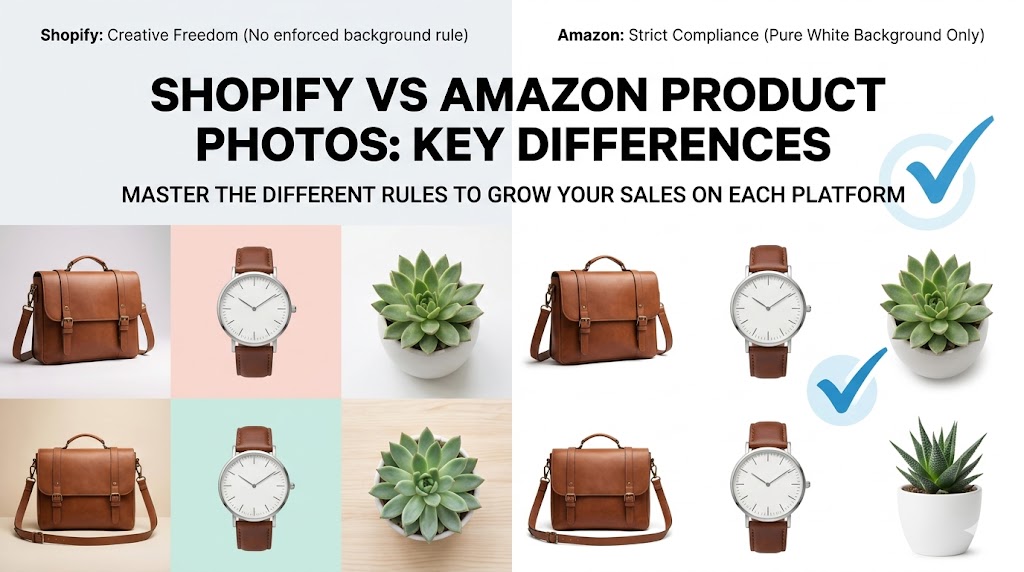
Nothing separates the Shopify vs Amazon product photos requirements more than background rules. This is where most cross-platform sellers hit their first wall.
Amazon Demands Pure White
Amazon requires the main image to sit on a pure white background at exactly RGB 255, 255, 255. There is no flexibility here.
Amazon’s automated systems scan every upload and flag any background that is not pure white. This is one of the sharpest Shopify vs Amazon product photos distinctions sellers discover after their first rejection.
Shopify Gives You Freedom
Shopify has no background requirements at all. You can use white, colored, gradient, or full lifestyle backgrounds without any risk of rejection.
This freedom is powerful in Shopify vs Amazon product photos, but it comes with a catch. Consistency is now your job. A messy mix of backgrounds across your Shopify catalog undermines the professional look that builds buyer trust.
The smart move on Shopify is to choose one background style and apply it across your entire catalog.
Technical Specifications Compared
Both platforms reward high-resolution square images, but the exact numbers and minimums differ. Here is how the core specs stack up.
Amazon Image Specs
Amazon’s technical rules are strict and tied directly to listing visibility:
- Minimum size: 1,000 px on the longest side to enable zoom
- Recommended size: 1,600 to 2,000 px on the longest side
- Maximum file size: 10 MB
- Frame fill: Product must occupy at least 85% of the frame
- Main image: Pure white background, no text, logos, or props
- Accepted formats: JPEG, TIFF, PNG, GIF
Shopify Image Specs
Shopify’s guidance is built around theme display and page speed, not rejection:
- Recommended size: 2,048 x 2,048 px in a 1:1 square
- Zoom threshold: Images must exceed 800 x 800 px to enable zoom
- Maximum size: 5,000 x 5,000 px and 20 MB
- Preferred format: JPEG at 80 to 85% quality for product shots
- Background: No requirement, but consistency is recommended
- Image limit: Up to 250 images per product
You can confirm Shopify’s current recommendations in their official website image size guidelines.
Main Image vs. Gallery Strategy
Both platforms separate the main image from supporting images, but the Shopify vs Amazon product photos approach expects different things from each slot.
How Amazon Handles It
Amazon locks down the main image with zero tolerance for creativity. When comparing Shopify vs Amazon product photos for the main slot, Amazon requires a clean, white-background product shot and nothing else.
The freedom lives in slots two through nine on Amazon. For Shopify vs Amazon product photos in the gallery, Shopify lets you add lifestyle shots, infographics, feature callouts, and colored backgrounds to drive conversions.
How Shopify Handles It
Shopify treats every image slot the same. In Shopify vs Amazon product photos terms, there is no enforced “main image” standard on Shopify, so you control the full visual narrative from the very first image.
This lets you lead with a lifestyle hero shot if your brand calls for it. The trade-off is that no system protects you from a weak first impression.
Creative Freedom vs. Strict Compliance
The biggest mindset shift between platforms is creative latitude. Each approach has clear advantages and clear risks.
Amazon’s strict rules create a level playing field but limit your branding. Your photos must compete on clarity and quality within tight boundaries.
Shopify rewards storytelling and brand identity. You can build an immersive, on-brand gallery, but you also carry the full burden of looking professional.
Common Cross-Platform Mistakes to Avoid
Sellers who manage both stores tend to make the same avoidable errors. Watch for these:
- Uploading a lifestyle hero image as the Amazon main image, triggering suppression
- Reusing off-white Amazon shots that look inconsistent on a branded Shopify store
- Ignoring the 85% frame-fill rule on Amazon and shrinking product visibility
- Forgetting alt text on Shopify, which hurts SEO and accessibility
- Uploading non-square images that get awkwardly cropped in Shopify themes
A single image set rarely fits both platforms perfectly. Plan your shoots with both endpoints in mind.
Get a Free Test Image Before You Commit
Editing one photo set to satisfy two different rulebooks is tedious, especially across a large catalog. One wrong background value can suppress an Amazon listing or cheapen a Shopify store.
That is the exact problem we solve at Photo Fix Team. We handle pure white backgrounds for Amazon and consistent, on-brand edits for Shopify so every image performs where it lives.
See the difference for yourself. Send us one product photo and we will edit it to full platform compliance, completely free. Claim your Free Test Image here and see how a perfectly optimized listing should look.
Quick Comparison Table
Here is the Shopify vs Amazon product photos breakdown at a glance:
- Background: Amazon requires pure white; Shopify allows any
- Enforcement: Amazon auto-suppresses; Shopify never rejects
- Recommended size: Amazon 1,600 to 2,000 px; Shopify 2,048 x 2,048 px
- Main image: Amazon strict; Shopify flexible
- Creative control: Amazon low; Shopify high
- Responsibility: Amazon enforces quality; you enforce it on Shopify
Frequently Asked Questions
Can I use the same product photos on Shopify and Amazon?
You can reuse secondary and lifestyle images, but the main image needs different treatment. The Shopify vs Amazon product photos difference is most visible here: Amazon requires a pure white background that may not match your Shopify brand style.
Does Shopify require a white background like Amazon?
No. Shopify has no background requirements, so you can use white, colored, or lifestyle backgrounds. Consistency across your catalog is recommended for a professional look.
What image size is best for both platforms?
A 2,048 x 2,048 px square works well for both. It exceeds Amazon’s zoom minimum and matches Shopify’s recommended size.
Why was my Amazon image suppressed but accepted on Shopify?
Amazon scans for compliance and suppresses non-white or text-heavy main images automatically. This is a core Shopify vs Amazon product photos compliance difference — Shopify performs no such checks, so the same image uploads without issue.
Do product photos affect SEO on both platforms?
Yes. Amazon images affect conversion and search ranking, while Shopify images affect page speed and image search through alt text. Both reward high-quality, optimized visuals.
Final Word
Shopify and Amazon reward different photo strategies because they serve different purposes. Amazon demands strict compliance, while Shopify rewards brand storytelling.
Master both rulebooks and you protect your Amazon listings while building a Shopify store that converts. When you would rather have it handled, Photo Fix Team is one free test image away.
🚀 Ready to Grow Your eCommerce Business with Professional Clipping Path Services?
Photo Fix Team delivers fast, precise, and affordable clipping path services for eCommerce businesses of all sizes — background removal, white background compliance, ghost mannequin, shadow effects, color correction, and bulk catalog editing with guaranteed quality.
Get a Free Quote Today →